Why localize, not just translate
Translating a post keeps the meaning. Localizing it keeps the meaning and makes it read like it was written for that audience in the first place — different examples, appropriate currency and date formats, idioms that actually exist in that language rather than word-for-word conversions of an English one.
Whether you need full localization depends on the content. A recipe post about ingredient substitutions probably needs real localization — measurement units, ingredient availability, and cooking terms vary by region. A product update announcement might be fine as a clean, accurate translation. Match the effort to what the content actually requires.
Pitfalls of literal machine translation
Word-for-word machine translation is fast but has predictable failure points worth watching for specifically:
- Idioms translated literally. A phrase that makes sense in English can become nonsense or unintentionally funny translated directly.
- Formality mismatches. Many languages have formal/informal registers (like tu/vous in French) that English doesn't distinguish — a direct translation can accidentally sound too casual or too stiff.
- Sentence structure carried over. English sentence order forced into a language with different natural structure reads as clearly translated rather than written.
- Cultural references that don't land. An example that resonates with an English-speaking audience may mean nothing to a reader elsewhere.
Generating content natively in the target language — rather than writing in English first and translating after — avoids most of these by construction, since the sentence structure and phrasing come from that language's own patterns rather than being carried over from another one.
Even a strong native-language draft should be reviewed by someone fluent before publishing, the same way you'd review any AI-assisted English draft before it goes live.
Tone and register across languages
Tone doesn't map cleanly across languages. A conversational, friendly tone in English might need to shift toward a more formal register in another language to land the same way with readers — what reads as "approachable" in one culture can read as "unprofessional" in another. This is one of the harder things to get right with any translation approach, machine or human, and it's worth explicitly deciding the intended register before generating or writing a localized post, rather than assuming it'll carry over automatically.
Formality isn't just a style preference in every language — in several, it's a grammatical choice with real social weight. French and German both distinguish formal and informal "you" (vous/tu, Sie/du), and Japanese has multiple layers of politeness built directly into verb forms. Picking the wrong register isn't a minor tone mismatch in these languages the way it might be in English — it can read as either presumptuous or oddly distant, depending on which direction you get it wrong.
If you're not fluent in the target language yourself, this is one area where a native reviewer earns their time more than almost any other check on the list — formality mistakes are exactly the kind of thing a non-native speaker won't catch by re-reading a translation carefully, because the sentence can look perfectly correct while still landing at the wrong social register.
Formatting details beyond the words
Tone and vocabulary get most of the attention in localization discussions, but a handful of smaller formatting details cause just as much friction when they're missed:
- Dates. "03/04/2026" means different days depending on whether a reader expects day-month-year or month-day-year. Spelling out the month avoids the ambiguity entirely.
- Currency. Convert or localize pricing where relevant rather than leaving a dollar figure in a post aimed at a market that doesn't use dollars.
- Measurement units. Metric versus imperial matters for anything practical — cooking, home improvement, distances — where a reader is expected to actually use the number, not just read it.
- Names and forms of address. Some languages expect a different order or formality of names than English defaults to; get this wrong in a greeting and it undercuts an otherwise well-localized post immediately.
None of these require deep language expertise to catch — they mostly require remembering to check for them, which is easy to forget when the bulk of your attention is on getting the sentences themselves to read naturally.
Technical setup: hreflang basics
Hreflang tags tell search engines which language and regional version of a page to show a given user. The basic pattern for a page available in English and Spanish looks like this in the page's <head>:
<link rel="alternate" hreflang="en" href="https://example.com/en/page/" /><link rel="alternate" hreflang="es" href="https://example.com/es/page/" /><link rel="alternate" hreflang="x-default" href="https://example.com/page/" />
Each language version should reference all its alternates, including itself. Get this wrong and search engines may show the wrong language version to the wrong audience, or index duplicate-seeming pages incorrectly. Most WordPress multilingual plugins handle hreflang generation for you once your language versions are set up — it's worth confirming yours does before assuming it's covered.
A common mistake worth checking for specifically: a hreflang tag pointing to a URL that returns a 404, or to a page that's actually been redirected somewhere else. Both quietly break the whole point of the tag — search engines end up with a broken signal instead of no signal, which can be worse than not implementing hreflang at all. Test each link directly after setup rather than assuming the plugin got every URL right.
Language switchers
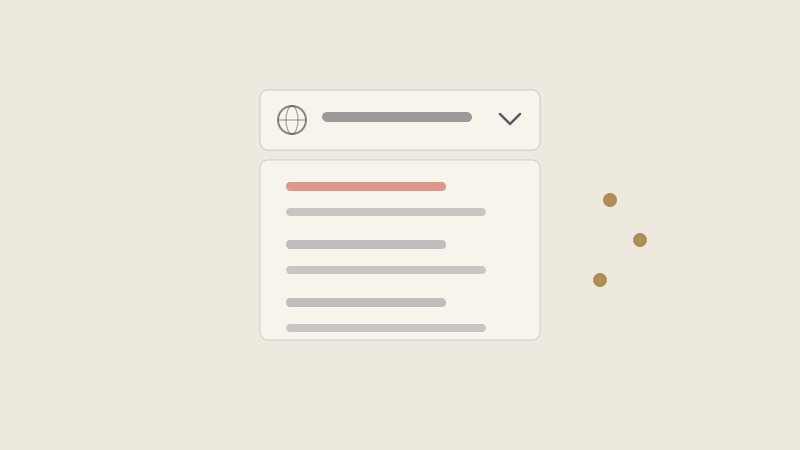
A visible, consistent language switcher — usually in the header or footer — matters more than it seems. Place it somewhere a visitor will actually see it on arrival, keep language names in their own language ("Español," not "Spanish"), and link each option to the equivalent page in that language, not just the homepage of that language version.
Avoid automatically redirecting visitors based on browser language or IP location without an easy way to override it. Automatic redirects that guess wrong — and they do guess wrong, for travelers, expats, and multilingual readers — are one of the more common sources of frustration on multilingual sites, and they can also interfere with search engines trying to crawl and index each language version properly. A visible switcher that lets someone choose is worth more than a "smart" redirect that occasionally gets it wrong for a real visitor.
Choosing which languages to start with
Look at your existing analytics location data and any support requests you've received in other languages before guessing. Real signals — visitors from a region despite no localized content, or repeated customer questions in another language — are a better basis for prioritization than assumptions about which markets "should" be next.
| Approach | Literal translation | Localization |
|---|---|---|
| Sentence structure | Often carries over source language patterns | Matches how the target language is naturally written |
| Idioms & examples | Converted word-for-word, can misfire | Replaced with equivalents that make sense locally |
| Tone & formality | Frequently mismatched to local register | Adjusted deliberately for the audience |
| Best generated by | Direct machine translation of an English draft | Native-language generation, then human review |
OptiPublish generates directly in 50+ languages from the same in-editor panel used for English drafts, which avoids the translate-after-the-fact step — though the review pass described in our guide to sounding less robotic still applies, in whichever language you're publishing. If you haven't nailed down your structure and SEO basics yet, our SEO checklist article applies across languages too.